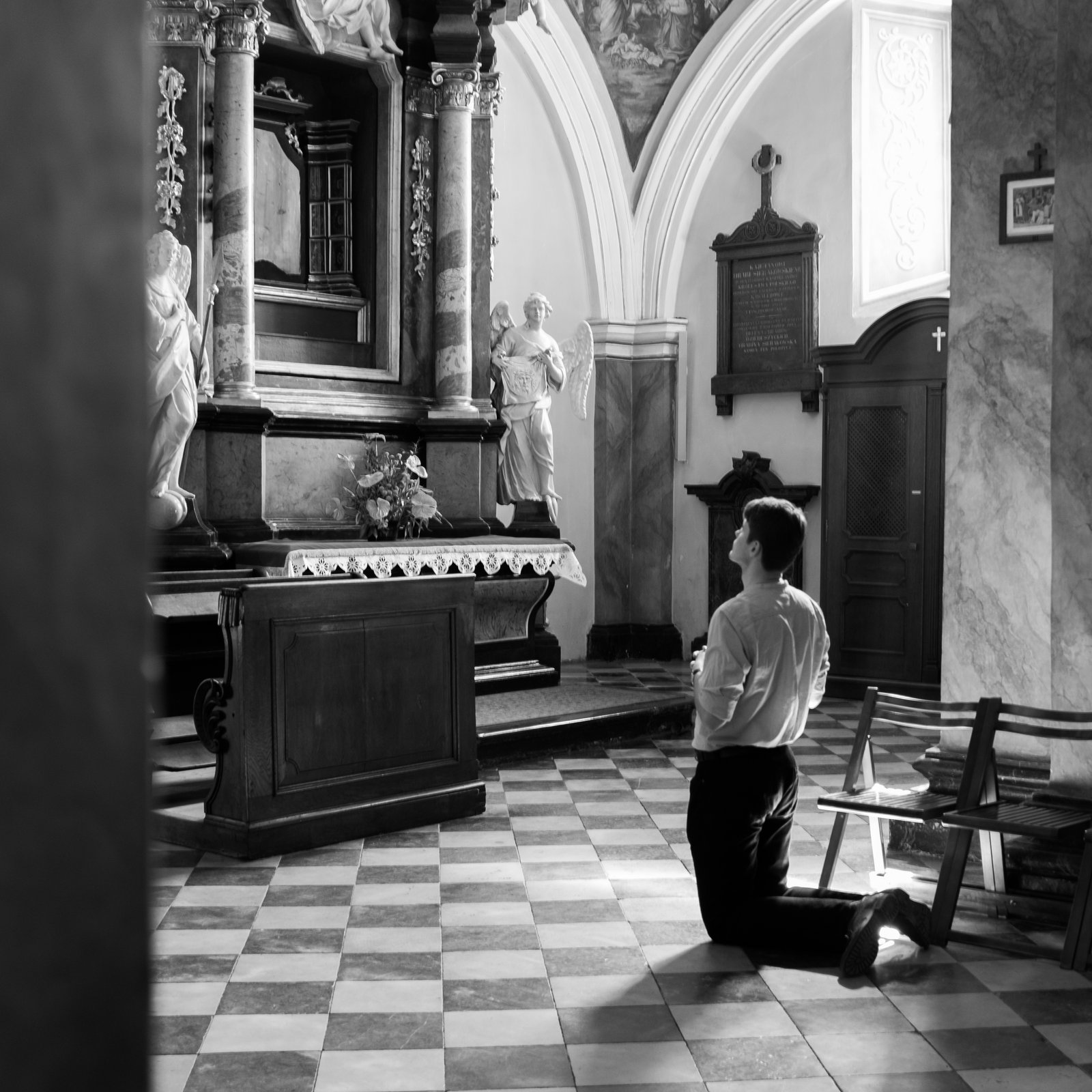
The set moves between two clear moods: hushed church interiors built on strict architectural symmetry, and looser color-and-motion street moments built on gesture and touch. Frame-within-frame devices - doorways, arches, pews - recur strongly in the opening third, then give way to closer, more physical human contact in the middle and later frames. Hands do a lot of the storytelling work throughout, from the praying figure to the coin exchange to the child reaching for bubbles. The two letterboxed color frames read as a distinct treatment inside the set rather than a one-off choice. As a whole it reads less like one continuous voice and more like two adjacent bodies of work sharing a camera and a city.
Key claims
The set's opening trio leans on near-identical architectural devices - checkerboard floors, dark wood, a single kneeling or seated figure inside an arch. ST-02 · ST-08
Three consecutive frames sharing the same location type and floor pattern reduce the perceived range of the set before the street material even starts.
Look at: The repeated checkerboard tile and dark carved wood across 01, 02, 03 · images 01, 02, 03
Hand gesture is the connective tissue between the color frames even though they differ in subject and setting. ST-05
This is the clearest cross-register throughline in the set and could be leaned on more deliberately in sequencing.
Look at: The praying hands in 03, the coin passed hand-to-hand in 06, the child's reaching arm in 08 · images 03, 06, 08
Two frames use a cinematic letterbox crop while the rest of the set uses the full native frame. ST-04
An inconsistent aspect treatment across only two of nine images reads as an unresolved formal experiment rather than a set-wide device.
Look at: The black bars top and bottom in 06 and 08 versus the full-bleed frame everywhere else · images 06, 08
Proximity to the subject varies sharply across the set, from close hand-level intimacy to distant environmental framing. ST-09
This swings the viewer's sense of engagement frame to frame rather than building a consistent vantage point.
Look at: The distant, small figure at the end of the corridor in 02 against the close hand-to-hand exchange in 06 · images 02, 06, 09
Composition
The set's clearest formal habit is using architecture - arches, doorways, pews - as a frame around the human subject, most visible in the opening third. Layering is attempted more than once but resolves cleanly only in the market-stall frame; elsewhere depth reads as busy rather than structured. The letterbox crop is a formal outlier that appears only twice, unresolved as a set-wide device.
— Arches, doorways and pew structures are repeatedly used to enclose the subject, forming the set's most consistent formal habit ST-02 · ST-06 · frames-within-frames · images 01, 02, 03, 05
— The receding corridor in 02 and the converging tunnel walls in 04 both use strong central perspective to pull the eye toward a distant figure ST-02 · leading lines / vanishing perspective · images 02, 04
— 05 stacks a foreground arch, a mid-ground vendor and a background seated figure that each stay legible; 09 attempts a similar depth but the background trees and figures read as texture rather than a second event ST-06 · foreground/background layering · images 05, 09
— The letterbox bars in 06 and 08 impose a hard horizontal edge not seen elsewhere in the set, changing how the eye enters those two frames ST-04 · edge treatment / cropping · images 06, 08
Coherence
The set does not read as a single unified eye so much as three related but distinct working modes captured by the same photographer in the same city. The church trio and street trio each have internal consistency; the color closing group is the least internally consistent, mixing a tight interior exchange, a wide outdoor gesture shot, and an environmental portrait.